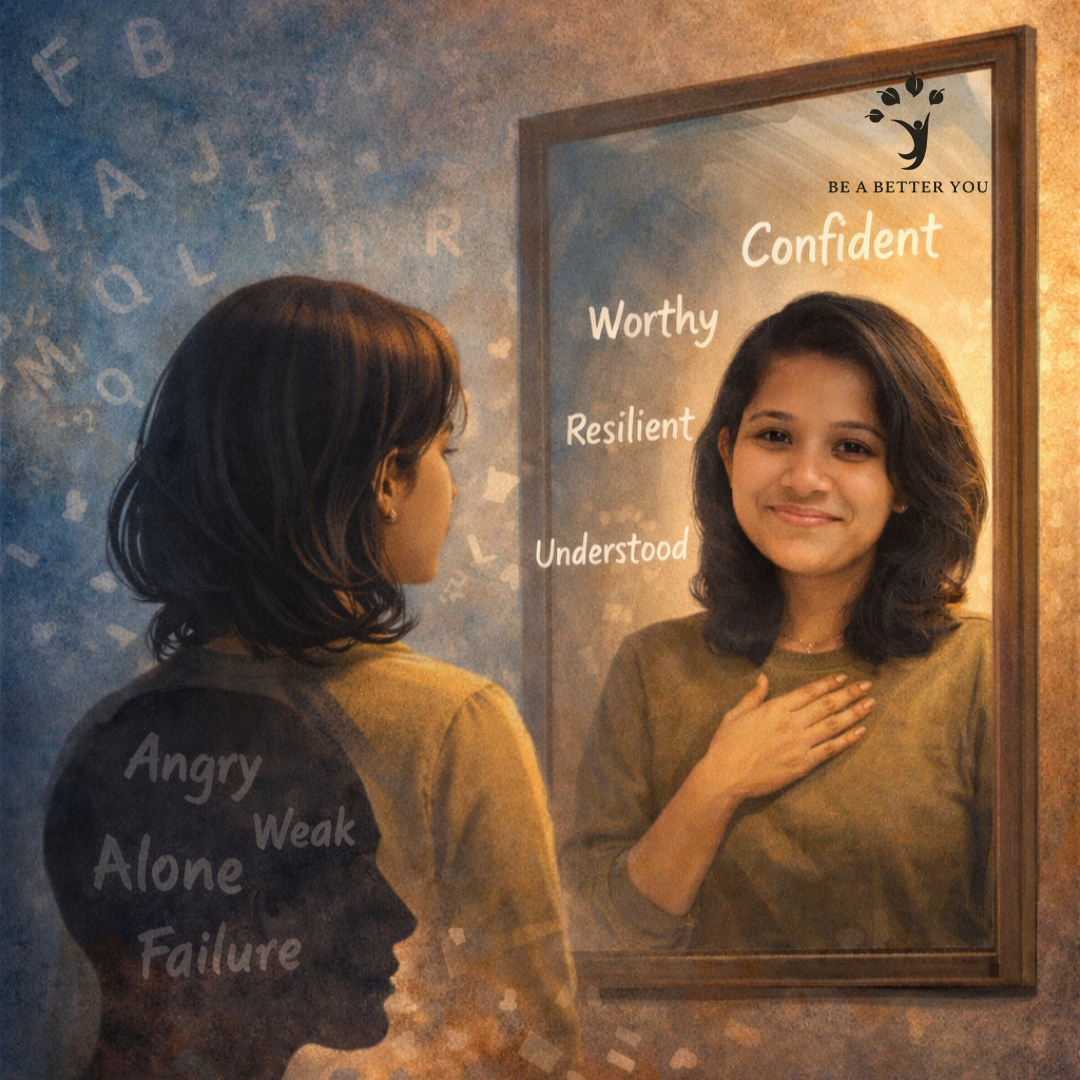
We teach children to build vocabulary so they can speak clearly and confidently. That is true, but it is only half the story. Words are not just tools for speaking. They are tools for thinking. And long before you communicate with the world, you communicate with yourself.
The moment something happens — joy, disappointment, fear, confusion — your mind reaches for a word. That word becomes the lens through which you understand your experience. The question is: how precise is that lens? How many words do you actually have available when you go looking inside yourself?
The vocabulary you carry determines how clearly you can see your own inner world. A richer inner language means richer self-understanding.
When One Word Has to Do Too Much Work
Think about how often someone describes a puppy, a newborn baby, and a person they deeply admire — all with the same word: cute. These are not the same experience. But without more precise language, every positive feeling gets flattened into a single sound.
The same thing happens with emotions, especially difficult ones. Most of us default to the word angry when we are upset. But pause for a moment. Is it really anger — or is it exhaustion wearing anger’s face? Does it hurt pretending to be frustrated? Is it the specific ache of feeling invisible, which is entirely different from the heat of feeling disrespected?
WHAT WE SAY VS. WHAT WE MIGHT ACTUALLY MEAN
|
We Say |
We Might Mean |
What It Really Is |
|
|
Angry |
→ |
Overwhelmed |
Too much, not enough space |
|
Angry |
→ |
Humiliated |
Dignity felt threatened |
|
Angry |
→ |
Betrayed |
Trust was broken |
|
Angry |
→ |
Exhausted |
Tired of trying so hard |
Each of these requires a different response — from yourself, and from the people around you. When you call them all “anger,” you are sending yourself and others in the wrong direction.
Intelligence Is Not the Same as Emotional Vocabulary
Here is something worth sitting with: academic success does not automatically build emotional literacy. A student who excels in mathematics or science may still struggle to name how they feel after a difficult conversation at home.
Emotional vocabulary grows differently. It grows through stories, through conversations that go deeper than the surface, through being around people who model how to articulate inner experience. If those experiences are absent — regardless of how intelligent or accomplished someone is — the emotional vocabulary stays thin.
And a thin emotional vocabulary is not a character flaw. It is simply a gap. One that can absolutely be filled.
It is not about intelligence. It is about language access. And language access can always be expanded — at any age, at any stage.
What Happens When We Cannot Find the Words?
When we cannot name what we feel, we do not stop feeling it. The emotion is still there — it just comes out sideways. It comes out with a sharper tone than intended. A reaction that confuses the people around us. A silence that feels like rejection when it is really just overwhelm.
Over time, this mismatch between inner experience and outer expression creates a kind of static in our relationships. People do not feel seen correctly. We do not feel understood. Neither side is necessarily wrong — the communication is simply reaching without the right vocabulary to land.
This is why working on emotional vocabulary is not a soft or secondary pursuit. It is foundational to every meaningful relationship we have — starting with the one we have with ourselves.
The Chain of Clarity
There is a quiet chain of events that unfolds when you expand your emotional language:
|
📖 Richer Vocabulary |
→ |
🔍 Name Emotions Precisely |
→ |
🌊 Process Them Calmly |
→ |
💬 Communicate Effectively |
→ |
🌱 Stronger Self-Image |
That last step — stronger self-image — is worth examining. When you cannot understand what you feel, you begin to doubt yourself. Confusion erodes confidence slowly, quietly. But when you can name your experience with precision, something shifts. You feel less at the mercy of your emotions and more like someone who can navigate them. That sense of navigation builds self-trust. And self-trust, over time, becomes a stronger, steadier sense of who you are.
Self-image is not built in the mirror. It is built in the moments when you understand yourself clearly enough to trust yourself fully
Vocabulary as a Practice of Self-Discovery
This is why building vocabulary — especially emotional vocabulary — is not a language exercise. It is a practice of self-discovery.
Every new word you learn for an emotion is a new room inside yourself that you can now enter, understand, and move through with more ease. Every time you pause and ask yourself, “Is this really anger, or is it something more specific?” — you are doing inner work. Real, meaningful inner work.
You do not need to become a poet or a philosopher. You only need to become a little more curious about your own experience, and a little more committed to finding the words that fit it honestly.
The quality of your words shapes the quality of your thoughts. And the quality of your thoughts shapes the person you become. 🌿
If this resonated with you and you want to explore emotional clarity more deeply, I would love to guide you further — through journaling, reflection, and the C.P.A.R. Method. Connect with me.
Enjoyed this article?
If you'd like a simple, structured way to stop overthinking and clear your mind through journaling, explore my book Mind Dump Method: Stop Overthinking in 10 Minutes a Day.
→ Explore the Boo